September 12, 2017

Analysis of 'How to Become a Writer' by Lorrie Moore

Lorrie Moore's 'How to Become a Writer' is narrated in the second person by a character named Francine. The story is told in the style of a self-help column directed to people who want to become writers, but the actual content of the story is extremely personal. Moore seems to be making fun of the idea that there exists a universal path to becoming a writer. The truth is that every writer has experienced their own unique journey and no two writers are alike. The narrator's strategy of presenting her own experience as a path that anyone can take is what gives the story a humorous tone.

This is the first of Moore's stories that I have read. I was drawn to the story by its title and immediately hooked after reading the first sentence: "First try to be anything else." Basically, the best way to become a writer is by trying to become something else.


"You will read somewhere that all writing that all writing has to do with one's genitals. Don't dwell on this. It will make you nervous."

This story is filled with statements like this that seem ludicrous at first but actually contain a deeper truth. Not all writing is completely focused on the writer's genitals but one could argue that the motivation to write often stems from sexual frustration.

 The other idea I found interesting from this story is the concept of writing as a kind of sickness. The narrator states that her obsession with writing causes her to lose weight and she compares being a writer to having polio. The narrator characterizes writing as a bad habit that causes her to lose interest in the more important things in her life. When the narrator reveals to her roommate her grand idea of adapting Moby-Dick, she responds by saying the two of them should go out for drinks. It seems like everyone except for the narrator and the other students in her creative writing classes think of writing as a waste of time. And yet this does not make the narrator any less motivated to write, which gives the narrator a heroic quality. She doesn't care what anyone else thinks and that makes her more attractive to the audience.

By far my favorite part of this story is the ending. Here we see the narrator on a dinner date with a man she describes as having a face like a blank piece of paper. What the narrator means by this is anyone's guess. To me it seems that she is once again relating her own motivation to write to her love life. Earlier Francine admits to using a college boyfriend's sense of humor to generate writing material. This idea was also reinforced when the narrator's roommate states at a cocktail party that the narrator's writing always has to do with her boyfriend. So at the end of the story, Francine remains inclined to use her love interests as fuel for her writing. When the narrator jokes that writing is a lot like having polio, her date responds by saying "interesting" and then by smoothing his arm hairs. This small exchange basically encapsulates society's response to hearing the crazy-sounding ideas of artists. Much of the time, when people with normal lives hear artists speak, they would rather do literally anything else. But people will say anything if they think it will get them laid. We put up with the crazy urges of others because we want them to like us. Lorrie Moore knows better than anyone else that creative writing is a fruitless endeavor 99% of the time. It's a somewhat bleak sentiment to express to an audience of aspiring writers but maybe it's exactly what that audience needs to hear.

If you found this article helpful, you can support Short Fiction Daily here: 

Buy Me a Coffe
September 5, 2017

Analysis of 'The Caretaker' by Anthony Doerr

Anthony Doerr is a writer of short stories and novels. Given his tremendous talent as a writer, it is surprising that Doerr is not more well-known. 'The Caretaker' is probably my favorite of his stories. I first read this story several years ago and certain images still linger with me today. This post will analyze key elements of 'The Caretaker' to better understand how the story works.

To begin I will provide a brief plot synopsis of this story.

'The Caretaker' is narrated in the third person by a nameless voice. The protagonist is Joseph Saleeby, a bookkeeper for the Liberian National Cement Company who embezzles a small amount of money each month. Joseph's life is very orderly and regimented until Liberia descends into a civil war that lasts 7 years. Joseph's mother disappears and he leaves his home. He wanders through his country witnessing horror after horror. At one point Joseph shoots a man who may or may not be innocent. Joseph leaves Liberia and finds himself on the Oregon Coast where he is hired as a caretaker by a man named Mr. Twyman. This is where Joseph's actions become more ambiguous and the story increases in complexity.

An Intensity of Detail


To put it simply, Doerr is a master of injecting realistic details into his stories. One could argue that plot is secondary to the detailed descriptions of the objects and things present in the story. Having such an incredible amount of detail brings the story to life and makes imagining the events easier. I imagine that a lot of research went into creating such vivid and realistic descriptions.

Whale Hearts


The defining moment of this story is when Joseph takes it upon himself to bury the hearts of five beached sperm whales. For Joseph, this act is an attempt to atone for the sins he committed in Liberia. It's clear that Joseph has been traumatized. For much of the story, Joseph's actions seem to make very little sense. It's no surprise that Joseph still feels distraught after this difficult act. Perhaps we can look at Joseph's actions in contrast to those of other people who seem to be scavenging whatever they can get from the whales' corpses.

This section of the story almost has a comedic tone to it. I can't help but laugh as Joseph first saws through a decaying whale carcass and then labors to bury them in a massive whole.

"he had told himself it would be like cleaning a fish, but it is completely different - it's more like eviscerating a giant."

This is the kind of thing that would only exist in fiction. What exactly this moment means is still a mystery to me. Joseph feels bad for the whales so he saws through their organs and buries their hearts in a giant whole in the ground.

"The hearts are still there, sitting just beneath the earth, waiting. What good does burying something really do? In nightmares it always manages to dig itself out."

This quote encapsulates what I believe to be the main idea of 'The Caretaker'. Essentially, the idea is that one cannot heal from trauma by burying or neglecting one's emotions. One must face the emotions head on to truly recover. Many of Joseph's decisions stem from a desire to bury his emotions deep within like whale hearts in the dirt. Joseph has this realization and then strategically pivots to burying things that will grow such as seeds.

I find 'The Caretaker' to be truly remarkable but also kind of a bummer to read. I read fiction because I am obsessed with stories and figuring out how they work and I can't help but see 'The Caretaker' as somewhat disappointing. The majority of time is spent with a deeply traumatized man as he labors without any reward. The story's ending does contain some hope as Joseph learns that he can go back to Liberia, but what good is that when Joseph's entire life there has been destroyed?

Ultimately 'The Caretaker' serves to engage readers with an alternate version of reality. Few things in the story make sense and that is okay. Fiction creates experiences that not good or bad. They are simply experiences.

If you found this article helpful, you can support Short Fiction Daily here: 

Buy Me a Coffe

August 13, 2017

Late Fragment by Raymond Carver Analysis

And did you get what
you wanted from this life, even so?
I did.
And what did you want?
To call myself beloved, to feel myself
beloved on the earth.


I am no stranger to Raymond Carver's prose but I cannot say the same for his poetry. Carver is known for a minimalist style championed by his editor and teacher Gordon Lish. These days I find it harder and harder to sit down and read an entire story. Perhaps looking at poetry will get me back in the groove of reading and writing about literature.

The first thing I noticed about Carver's poem 'Late Fragment' is its short length. The poem is six lines long and one line is only two words. The poem reads quickly. I felt I understood the poem completely after reading it two or three times. Lines two and four as a question that is then answered in the following line.

Enough about the poem's structure. Let's get into the content. The repetition of the question "what did you want?" seems to be the essence of the poem. The speaker is asking this question to himself or perhaps to someone else. Whoever is answering the question knows that he has got exactly what he wanted from life. It's the kind of question one would ask in his or her final moments when there is nothing to hide. In typical Carver fashion, the answer is frank: "to call myself beloved, to feel myself beloved on the earth." 

Love is a prominent theme in Carver's fiction as well as in his poetry. I think we could all use a bit more love in the world, especially given the current political climate. We can look to writers such as Carver to remind us what is important in life. What's important to Carver is feeling loved and calling himself loved. It's a simple answer to a question that is often answered with money, power or fame.

Thank you Raymond Carver for reminding me what is truly important in life.

June 12, 2017

Analysis of 'Sea Oak' by George Saunders

I have read many of George Saunders' stories over the past few years. It's surprising that I have yet to write about 'Sea Oak'. The hero of this story works as a male stripper at an establishment called Joysticks. It's common for the customers at Joysticks to offer the employees money in exchange for a flash of the genitals or a picture of a butt. Clearly the men working at Joysticks are objectified yet the main character seems grateful for his job. Perhaps the fact that he is rated a "honeypie" provides a boost to his self-esteem.

Saunders is no stranger to inventing bizarre work environments. This is actually one of his go-to techniques as a fiction writer. The heroes of these stories encounter problems when they fail at their jobs (see 'The Wavemaker Falters') or they are pressured to break the rules. (see 'Offloading for Mrs. Schartz'). Sea Oak is different because the inciting incident of the story involves the hero's life away from work.

Humor is the most effective element of 'Sea Oak'. If any story proves that Saunders is a master of comedy, this is probably the best example. It seems like every section ends in a punchline that propels you into the next section. Sometimes it feels as though the jokes are making fun of the characters so I could see how someone might find the humor offensive. But this type of humor usually works on me pretty well.

There are so many things going on in 'Sea Oak' that it can seem a bit overwhelming. The most integral part of the story is the death and resurrection of Aunt Bernie. There is no explanation for why this happens. Aunt Bernie rises from the dead to deliver life advice to the members of her family. "Show your cock" she says to the narrator so that he can make more money at work. I wonder how Saunders conceived of this aspect of the story because it's ludicrous. This foreshadows some of the bizarre plot events that occur in his later stories.

'Sea Oak' ends on a strangely uplifting note. The is a story where the characters seem to be on a downward spiral into poverty. The narrator's plan to "show his cock" seems to work because he is planning to move his family into a safer apartment. But I would hesitate to call 'Sea Oak' an inspiring story. After reading 'Sea Oak" you come away with better understanding of people living in austere environments. If you have lived you entire life comfortably, then this is an important idea to learn.

If you found this article helpful, you can support Short Fiction Daily here: 

Buy Me a Coffe


June 7, 2017

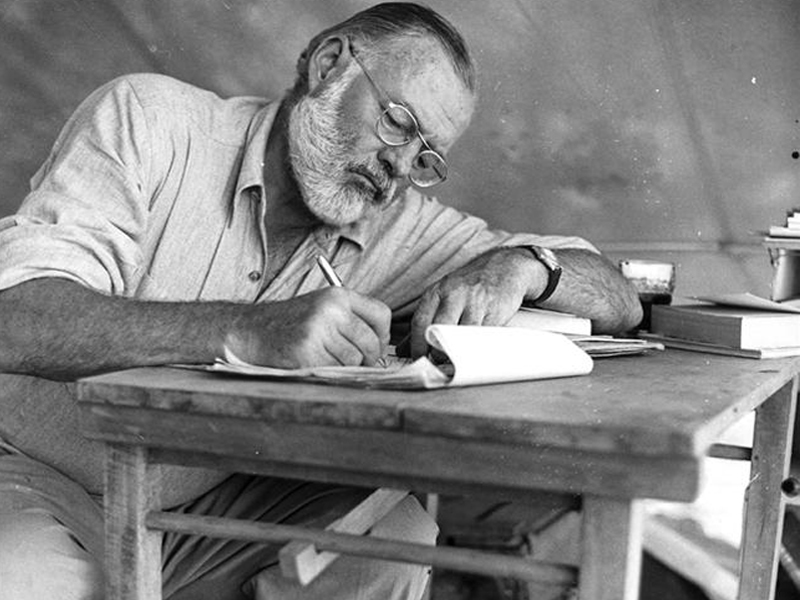
Ernest Hemingway Wearing Glasses

Here is every photo ever taken of Earnest Hemingway wearing glasses.

Hard at work.

Pondering the nature of the universe.
"Hey! I like your beard"
No comment.
Those yellow shades really complement your eyes


June 3, 2017

Analysis of 'Television' by Lydia Davis

Lydia Davis is known for her experimental stories that are often quite compact. She experiments with form more than any other contemporary writer. 'Television' is a four-page exploration of what television does for people watching it and how television makes life better.


Imagery


In describing what is on TV, the narrator uses vivid imagery. There are zombies, a woman with a pearl necklace, a mother with bad teeth, a father with a broad smile. The images we see on television are so realistic that reality becomes secondary. Or perhaps reality is filtered through the medium of television, but it is always someone else's reality. The voyeurism of watching television is what makes it so appealing but this would not be possible without the realistic and vivid pictures that TV displays.


Unique Structure


'Television' is divided into three distinct sections that are roughly the same length. The first section focuses on the reasons why people watch television. There are many sentence long paragraphs. The second section is also choppy with several paragraphs separated by a single line. The third section contains four longer and connected paragraphs about the narrator's individual experience watching movies late at night. TV becomes an escape for the narrator away from her own life and into other more interesting lives. The many line breaks and transitions has the effect of giving the story a faster pace and it makes the story easy to read. I feel that the structure of the piece is a reflection of the narrator's internal dialogue.


Moral of the Story


After reading this story over a few times, I came to the conclusion that TV is quite helpful. TV seems like the perfect tool for escaping from your own life when it gets stressful and TV also provides entertainment. While the story never explicitly states that TV is good, it can be inferred from statements such as, "there is some real satisfaction in getting this information about the next day's weather" or "they say it will be exciting and it always is"

For a lonely person, television can be a godsend. Rather than waste away doing nothing, TV at least provides a way of killing time that is not entirely useless. For busy people, television is a welcome distraction from the stress and monotony of daily life. Television, when used responsibly, is an amazing tool. If you have been raised your entire life with television, it is incredibly difficult to imagine life without it.

Television is good. This was my takeaway from reading 'Television' by Lydia Davis.

If you found this article helpful, you can support Short Fiction Daily here: 

Buy Me a Coffe

March 22, 2017

"Any Corpse" by Brian Evenson

An unforgettable masterpiece from the best horror writer working today.


As I read through Brian Evenson's latest collection of stories "A Collapse of Horses" certain stories linger with me longer than others. The first story with such an effect is "Black Bark" which you can read my thoughts on here. Another story that is difficult story to forget is "Any Corpse" which I am going to write about now.

"Any Corpse" begins with a shower of raw flesh falling from the sky. We have a female POV observing furnishers, human-like creatures that prod at the raw flesh and attempt to sell it in exchange for beads. We then learn that our female protagonist desires an alive and in tact human body. The premise of this story is bizarre to say the least. We learn that our protagonist is one of many who live in caves and who possess a tablature used to perform a ritual. Later the protagonist asks the furnishers for a corpse. The furnishers respond by asking "what corpse?" to which the protagonist says "any corpse," so long that it is freshly dead. The protagonist fails to understand that "any corpse" includes herself so she is killed by the furnishers. 

After the furnishers kill the protagonist, they expect the protagonists corpse to provide payment. The furnishers would almost be adorable if they weren't murderous humanoid creatures who make a living selling flesh. What's frustrating about this story is that we don't know enough about the furnishers. Why are they called furnishers? What are beads and why do the furnishers desire them? I would very much like to pick Evenson's brain to understand where he got the inspiration for this story.


In the second half of this story, we switch to a male protagonist in the same situation as the first one. He also is searching for a recently deceased body. He meets up with some furnishers and buys the woman's body from the first half. He performs a ritual that revives the corpse and begins asking questions. The corpse is not exactly cooperative. She ends up spitting in the mans face before she dies again for good. 

Later on our male protagonist intends to cook and eat the woman's body. A group of furnishers come to the man's cave. The man asks for another body and ends up making the same mistake as the woman by saying that any corpse will do. The story ends with the furnishers gathered outside of the cave saying "person please out of cave."

While reading Evenson's stories, I often feel just as confused as the characters in said stories. I find myself motivated to read his stories because I want to understand the mysterious events taking place. Unfortunately I am never able to satisfy this urge. When the story ends I am just as clueless as when I started reading. Evenson does not explain why his stories are so weird. Doing so would take away from their power. Evenson's best technique is how he creates such disturbing stories without ever explaining how they work. It is clear that too much explanation would be detrimental to the effect that Evenson hopes to create. The more that we understand what's going, the more comfortable that we feel. Evenson is clearly a literary madman whose goal is to make his readers as confused and as disturbed as possible.

If you found this article helpful, you can support Short Fiction Daily here: 

Buy Me a Coffe