Showing posts with label themes. Show all posts

June 23, 2026

A Rose for Emily by William Faulkner: Summary, Meaning, and Analysis


William Faulkner's "A Rose for Emily" is one of the most widely anthologized short stories in American literature. It's often assigned in high school and college literature courses because it rewards multiple readings. On the surface, the story reads like a Southern Gothic mystery. Beneath that mystery, however, Faulkner explores themes of time, memory, tradition, isolation, and humanity's inability to let go of the past.

What makes the story especially memorable is its structure. Faulkner tells Emily Grierson's life out of order, forcing readers to piece together the truth for themselves. The famous ending is shocking, but the story's lasting power comes from what it reveals about loneliness and the destructive effects of living entirely in the past.

Plot Summary

The story begins with the death of Miss Emily Grierson, an elderly woman who has become a fixture of the town of Jefferson. The townspeople attend her funeral out of curiosity as much as respect.

Through a series of flashbacks, we learn about Emily's life. She comes from a once-prominent Southern family and lives in a decaying mansion that has become a relic of an earlier era. Her controlling father drives away potential suitors, leaving her isolated and unmarried.

After her father dies, Emily refuses to acknowledge his death for several days. Eventually she becomes involved with Homer Barron, a Northern laborer overseeing a paving project in town. The relationship becomes the subject of intense gossip. Emily later purchases arsenic, leading many townspeople to believe she plans to kill herself.

Homer disappears shortly afterward. Emily withdraws from public life and spends decades living in near-complete isolation.

After Emily's death, townspeople force open a sealed upstairs bedroom. There they discover Homer's decayed corpse lying in a bed. Beside it is a second pillow bearing the indentation of a head and a single strand of Emily's gray hair, revealing that she spent years sleeping next to the dead man she could not bear to lose.

What Does "A Rose for Emily" Mean?

At its core, "A Rose for Emily" is a story about the refusal to accept change.

Emily spends her entire life resisting reality. She refuses to acknowledge her father's death. She refuses to pay taxes. She refuses to modernize her house. Most horrifyingly, she refuses to let Homer Barron leave her.

The town behaves similarly. The citizens treat Emily less like a person than a monument to a disappearing Southern past.

Early in the story, the narrator describes her this way:

"Alive, Miss Emily had been a tradition, a duty, and a care."

This is one of the most important lines in the story. Emily is not viewed as an individual. Instead, she has become a symbol. The townspeople inherit responsibility for her in the same way they inherit local customs and traditions.

Faulkner suggests that both Emily and the town are trapped by the past. Neither can fully move forward.

The Narrator: Why Does Faulkner Use "We"?

One of the most unusual features of the story is its narrator.

Rather than telling the story from Emily's perspective, Faulkner uses a collective first-person narrator. The story is told through the voice of the town itself.

Throughout the story, the narrator repeatedly uses words like "we," "our," and "us."

This choice creates an interesting effect. Readers never truly know Emily. We know only what the townspeople know, and often they don't know much at all. Much of the story consists of rumors, assumptions, and speculation.

The townspeople constantly watch Emily. They judge her, pity her, criticize her, and gossip about her. Yet despite this obsession, they fail to understand her.

In many ways, the town becomes a character of its own.

Emily's tragedy unfolds in public, but her inner life remains hidden.

Emily and Her Father

One of the most revealing passages in the story occurs when the narrator describes Emily and her father:

"We had long thought of them as a tableau, Miss Emily a slender figure in white in the background, her father a spraddled silhouette in the foreground..."

The image resembles a painting.

Notice where Emily stands. She is pushed into the background while her father dominates the foreground.

This image helps explain much of Emily's life. Her father controls her relationships and isolates her from potential partners. By the time he dies, Emily has spent decades living under his influence.

When she refuses to surrender his body after his death, the moment feels bizarre. Yet it also reveals how completely her identity has become attached to him.

The pattern repeats later with Homer Barron. Once again, Emily cannot let go.

Time and Structure

One reason "A Rose for Emily" remains so effective is its non-linear structure.

Faulkner does not tell Emily's life chronologically. Instead, he moves backward and forward through time.

A less skilled writer might have told the story in a straightforward sequence:

  • Emily's childhood

  • Her father's death

  • Homer Barron

  • Emily's isolation

  • The discovery of the corpse

Faulkner does the opposite.

By scattering information throughout the narrative, he transforms a tragic story into a mystery. Readers constantly revise their understanding as new information appears.

The structure also reinforces one of the story's central themes. Emily herself cannot experience time normally. She lives as though the past never ended. The fragmented chronology mirrors her inability to move forward.

Southern Gothic Elements

"A Rose for Emily" is often classified as Southern Gothic fiction.

Southern Gothic stories combine ordinary life with decay, violence, obsession, and the grotesque.

Faulkner fills the story with images of decline.

Emily's house once stood proudly in an elegant neighborhood. Now it sits surrounded by garages, cotton gins, and gasoline pumps. The mansion itself becomes a symbol of a dying social order.

Dust appears throughout the story. Rooms are sealed off. Furniture decays. People grow old and disappear.

The physical deterioration of the house mirrors Emily's psychological deterioration.

By the end of the story, both Emily and her home have become tombs.

The Ending Explained

The ending of "A Rose for Emily" is one of the most famous in American literature.

After Emily's funeral, townspeople break into a locked upstairs room and discover Homer Barron's corpse.

Faulkner describes the scene in unforgettable detail:

"The body had apparently once lain in the attitude of an embrace, but now the long sleep that outlasts love, that conquers even the grimace of love, had cuckolded him."

 This passage reveals why the story's ending is so effective. Faulkner never directly states that Emily murdered Homer and spent years sleeping beside his corpse. Instead, he allows readers to discover the truth through details and implication.

The horror comes not only from the corpse itself but from what it reveals about Emily's emotional state. She has spent her life losing the people closest to her. First her father dies. Then Homer appears ready to leave her. Faced with another abandonment, Emily chooses a horrifying solution: she ensures that Homer can never leave at all.

The final image of the gray hair on the pillow transforms the story from a murder mystery into a tragedy. The discovery suggests years of loneliness, denial, and psychological collapse.

What Writers Can Learn From "A Rose for Emily"

One reason writers continue studying this story nearly a century after its publication is that Faulkner demonstrates several storytelling techniques at an extremely high level.

Tell the Story Out of Order

Many beginning writers assume stories should be told chronologically.

Faulkner proves otherwise.

The smell, the poison, Homer's disappearance, and the locked room all appear long before readers understand their significance. Each detail functions like a puzzle piece.

The result is a story that demands active participation. Readers are constantly revising their understanding as new information appears.

Rather than creating confusion, the fragmented structure creates curiosity.

Withhold Information Strategically

Faulkner's greatest skill in this story may be his ability to withhold information.

Notice how often he places readers in the same position as the townspeople. We hear rumors. We witness strange behavior. We make assumptions.

Yet we never gain direct access to Emily's thoughts.

This restraint makes the ending significantly more powerful. If Faulkner had explained everything directly, much of the mystery would disappear.

Use Setting as Character

Emily's house is one of the most memorable settings in American fiction. 

Early in the story, the narrator describes it as:

        "lifting its stubborn and coquettish decay above the cotton wagons and the gasoline pumps—an             eyesore among eyesores."

The house mirrors Emily herself.

Both belong to an earlier era.

Both resist change.

Both become isolated from the modern world around them.

By the story's conclusion, the distinction between Emily and the house almost disappears. They have aged together, decayed together, and become monuments to a vanished past.

Trust the Reader

Perhaps the most important lesson is that Faulkner trusts his audience.

He does not overexplain.

He does not summarize every theme.

He does not tell readers exactly what to think about Emily.

Instead, he presents images, events, and contradictions. Readers must draw their own conclusions.

That trust is one reason the story remains so rewarding to reread.

Final Thoughts

Many readers remember "A Rose for Emily" because of its shocking final revelation. The corpse in the upstairs bedroom is certainly unforgettable. Yet reducing the story to its twist misses what makes it great.

At its heart, "A Rose for Emily" is a story about people who cannot let go.

Emily cannot let go of her father. She cannot let go of Homer Barron. She cannot let go of the social world that gave her family status and meaning.

The town struggles with the same problem. Its citizens treat Emily as a living relic, preserving her as a symbol of a past that no longer exists.

The result is a story filled with dust, memory, and decay. Everything in Jefferson seems caught between what was and what is.

Nearly a hundred years after its publication, "A Rose for Emily" remains compelling because its central fear is still recognizable. Most people will never lock themselves away in a decaying mansion. Most people will never commit Emily's terrible act.

But almost everyone understands the desire to hold on to something that is already gone.

That human impulse—more than the murder, the mystery, or the Gothic atmosphere—is what gives Faulkner's story its lasting power.

If you found this article helpful, you can support Short Fiction Daily here: 

Buy Me a Coffe

November 28, 2017

Analysis of 'How' by Lorrie Moore

Today I am talking about 'How' by Lorrie Moore. This is the second story in Moore's collection 'Self-Help' that I will have written about. A common technique in the collection is the use of the second person. The title of 'How' suggests little in terms of what the story is about which is strange because the story does seem to focus on one particular theme: the difficulty of being in a relationship.

The first thing that struck me about 'How' is its form. The story is composed of several blocks of text that are separated by line breaks. There are a few single sentence paragraphs but most of the blocks contain approximately 5-6 sentences. In general the blocks feel somewhat related in terms of their subject matter but they also change quite a bit. This unique style means that you could start reading at pretty much any point in the story and you wouldn't feel any more or less lost than if you started at the beginning.

The main focus of this story is romance. The story's speaker is giving the reader a glimpse into the intimate details of her relationships with numerous men. Similar to other stories in "Self-help" the speaker's tone is that of a mentor or expert providing advice on how to do something. In the case of 'How' the speaker is telling us how to act in relationships without really stating an overarching objective. I did not get the impression that following the speaker's advice would be a wise decision. There is a lot of tension between the narrator and her various lovers.

I greatly admire Moore's writing for its experimentation with form and language, but I find it hard to muster up enough motivation to discuss her work. Her tendency to write about romantic conflict simply does not interest in me in the way that other stories do. It is difficult to discuss the content of a work that upsets you no matter how much you appreciate the writing style of that work.

"There will be an endless series of tests"

Being in a relationship can feel like a constant struggle. The speaker of 'How' feels like she must meet the demands of others over and over again. This sentence reminds me of shit tests, a way of measuring someone's worthiness as a mate by presenting them with a question. I have encountered these before and they are an unavoidable part of being in a relationship. A shit test is usually veiled in some way to appear less important than it actually is.

"The sadness will die like an old dog. You will feel nothing but indifference."

I can't help but feel bad for the narrator. She seems to have good intentions but her actions inevitably lead her down a path of despair. Changing your habits is one of the hardest things to do. While I have a hard time relating to the romantic trials of a single woman, I can empathize with the more general problem of being stuck with a bad habit. Simply put, being able to break a bad habit is one of the most difficult yet integral things that a person can do to make his or her life better.

While reading 'How to Become a Writer' I found myself unable to stop reading. Reading 'How' is a much different experience. Moore's thoughts about writing are insightful and relevant to myself as a creative person but I find her writing about relationships to be much less appealing.

If you found this article helpful, you can support Short Fiction Daily here: 

Buy Me a Coffe


September 5, 2017

Analysis of 'The Caretaker' by Anthony Doerr

Anthony Doerr is a writer of short stories and novels. Given his tremendous talent as a writer, it is surprising that Doerr is not more well-known. 'The Caretaker' is probably my favorite of his stories. I first read this story several years ago and certain images still linger with me today. This post will analyze key elements of 'The Caretaker' to better understand how the story works.

To begin I will provide a brief plot synopsis of this story.

'The Caretaker' is narrated in the third person by a nameless voice. The protagonist is Joseph Saleeby, a bookkeeper for the Liberian National Cement Company who embezzles a small amount of money each month. Joseph's life is very orderly and regimented until Liberia descends into a civil war that lasts 7 years. Joseph's mother disappears and he leaves his home. He wanders through his country witnessing horror after horror. At one point Joseph shoots a man who may or may not be innocent. Joseph leaves Liberia and finds himself on the Oregon Coast where he is hired as a caretaker by a man named Mr. Twyman. This is where Joseph's actions become more ambiguous and the story increases in complexity.

An Intensity of Detail


To put it simply, Doerr is a master of injecting realistic details into his stories. One could argue that plot is secondary to the detailed descriptions of the objects and things present in the story. Having such an incredible amount of detail brings the story to life and makes imagining the events easier. I imagine that a lot of research went into creating such vivid and realistic descriptions.

Whale Hearts


The defining moment of this story is when Joseph takes it upon himself to bury the hearts of five beached sperm whales. For Joseph, this act is an attempt to atone for the sins he committed in Liberia. It's clear that Joseph has been traumatized. For much of the story, Joseph's actions seem to make very little sense. It's no surprise that Joseph still feels distraught after this difficult act. Perhaps we can look at Joseph's actions in contrast to those of other people who seem to be scavenging whatever they can get from the whales' corpses.

This section of the story almost has a comedic tone to it. I can't help but laugh as Joseph first saws through a decaying whale carcass and then labors to bury them in a massive whole.

"he had told himself it would be like cleaning a fish, but it is completely different - it's more like eviscerating a giant."

This is the kind of thing that would only exist in fiction. What exactly this moment means is still a mystery to me. Joseph feels bad for the whales so he saws through their organs and buries their hearts in a giant whole in the ground.

"The hearts are still there, sitting just beneath the earth, waiting. What good does burying something really do? In nightmares it always manages to dig itself out."

This quote encapsulates what I believe to be the main idea of 'The Caretaker'. Essentially, the idea is that one cannot heal from trauma by burying or neglecting one's emotions. One must face the emotions head on to truly recover. Many of Joseph's decisions stem from a desire to bury his emotions deep within like whale hearts in the dirt. Joseph has this realization and then strategically pivots to burying things that will grow such as seeds.

I find 'The Caretaker' to be truly remarkable but also kind of a bummer to read. I read fiction because I am obsessed with stories and figuring out how they work and I can't help but see 'The Caretaker' as somewhat disappointing. The majority of time is spent with a deeply traumatized man as he labors without any reward. The story's ending does contain some hope as Joseph learns that he can go back to Liberia, but what good is that when Joseph's entire life there has been destroyed?

Ultimately 'The Caretaker' serves to engage readers with an alternate version of reality. Few things in the story make sense and that is okay. Fiction creates experiences that not good or bad. They are simply experiences.

If you found this article helpful, you can support Short Fiction Daily here: 

Buy Me a Coffe

February 20, 2017

"The Chameleon" by Chekhov

Summary and Analysis


"The Chamelon" is one of Chekhov's shorter stories at a length of nearly four pages but that doesn't make the story any less compelling. In classic Chekhov fashion, "The Chameleon" expresses a deep truth about human behavior in a detailed setting. The title refers to a police officer named Ochumelov (Russian for wacky) who changes his mind several times about how to act in a situation where he doesn't know all the facts.

Experience Chekhov's brilliant wit and deep insight for yourself—get your copy of The Chameleon and other timeless tales today!

At first Ochumelov is tempted to side with the man whose finger was bitten in part because the situation seems trivial and Ochumelov wants to dispense justice because it seems like a rational decision. When a member of a crowd yells that the dog belongs to a general, Ochumelov in turn assumes that the bitten man deserves all of the blame. Chekhov ends the story by revealing that the dog belongs to a general's brother. This reveal allows Ochumelov to settle on a decision to rescue the dog and punish the injured man.
The moral of this story is fairly easy to deduce. People change their behavior to suit their own needs regardless of how it affects others. When you really think about it, this is a sad lesson to learn. People will behave this way even in situations that with low stakes. The story's tension comes from the mystery of what really happened and the reader's uncertainty as to what will happen to the various characters in the story. Thankfully Chekhov lets us off the hook by allowing the dog to be saved and ending the story before the injured man can be further punished.

I'm curious as to whether Chekhov wrote this story as an allegory. My translation includes asterisks that reveal meanings behind the characters' names but these meanings seem to serve a comical function rather than an ethical one. I would say this is the most comedic Chekhov story I have read to date. Touches like a crowd appearing out of nowhere and Ochumelov's subtle facial expressions make this story feel like a cartoon. Chekhov realizes the humor in his stories even when the subject matter is quite dark.

If you found this article helpful, you can support Short Fiction Daily here: 

Buy Me a Coffe


February 7, 2017

The 400-Pound CEO

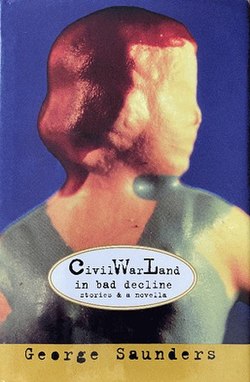
The 400-pound CEO is one of my favorite stories from George Saunders' collection CivilWarLand in Bad Decline. Like other stories by Saunders, the 400-pound CEO focuses on a character negative experience in a bizarre workplace. In this case the character is Jeffrey who works at Humane Raccoon Alternatives, a corporation that claims to release troublesome raccoons into the wild but actually kills them.

Jeffrey is frustrated at his lack of love life and his co-workers constantly make fun of him for being so overweight. Jeffrey has feelings for his coworker Freeda who is repulsed by Jeffrey but she accepts Jeffrey's invitation to dinner. Jeffrey and Freeda go out to Ace's Volcano Island, a Hawaiian themed restaurant run by an aging beatnik with Tourette's. It turns out that Freeda only went out with Jeffrey because their coworker Tim agreed to pay Freeda's phone bill. In response to this humiliation, Jeffrey goes on vacation for a week and does nothing but play a game called Oil Can Man. When Jeffrey returns to work, his life continues to consist of boring work, self-loathing and humiliating jokes about his weight.

While attempting to stop his evil boss Tim from attacking an animal rights girl with a camcorder, Jeffrey inadvertently kills him. In the moments after this event, Jeffrey realizes that his biggest concern in life is not lofty ideals but himself. Jeffrey then forges a letter in which Tim says that he is moving to Mexico and Jeffrey is the new CEO. Jeffrey's reign as the CEO is short-lived when his co-worker Claude discover's Tim's dead body. Jeffrey is arrested and sentenced to fifty years in prison where he continues to be humiliated but Jeffrey somehow refuses to give up his dignity.


One of my favorite things about Saunders' stories is how they combine funny and dark elements. It's a testament to Saunders' ability as a writer that this story can inspire such different reactions at different points. Reading about Jeffrey's struggles will most likely make you feel grateful for how much better your life is and that is quite the feat on Saunders part. By providing a glimpse into one of the saddest and most unfortunate people on Earth, Saunders, I believe, wants to make people feel better about their own lives.

At the end of this story, Jeffrey entertains the possibility that his life could restart if a benevolent higher power were to assume responsibility for his tragic life. This is the darkest moment of the story since we know that Jeffrey's life will never change unless he himself takes action. This moment speaks to Jeffrey's persistent ability to think that his life will get better. This ability is what enables Jeffrey to continue working even though his job sucks and his coworkers treat him like human garbage. The problem is that Jeffrey's life at the end of the story story is awful since he is serving a 50 year sentence for murdering Tim. When your life is really tedious and unfulfilling, you should maybe try something other than hoping that a higher power will fix your life.

If you found this article helpful, you can support Short Fiction Daily here: 

Buy Me a Coffe

November 8, 2016

Lydia Davis - The Professor

Lydia Davis. The Professor. Analysis. Summary. If you came looking for anything related to these words, then you came to the right place. I have been really digging Lydia Davis recently. Been reading her story collections and some scholarly articles on her work. I started with Break it Down and I'm currently reading Almost no Memory, which contains the story I am writing about today.

Lydia Davis is more philosophically concerned than the average writer. Her stories don't really possess narrative as you would traditionally think of narrative. Instead her stories exist in the minds of her characters. There is some action but it clearly takes place in the form of memory, which is less exciting than action that takes place in reality, but I don't really mind. It's all the same to me and I actually enjoy many elements of Davis's writing style. She's a good writer and more importantly, she's a writer who does her own thing regardless of what anyone else thinks. The following is a summary and analysis of Davis's story "The Professor".

Summary

The narrator tells us that a few years ago she fantasized about marrying a cowboy. She admits that she lives on the East Coast and she is currently married to a someone who is not a cowboy. The idea of marrying a cowboy is appealing because it would stop the narrator from thinking so much. Feel free to take offense if you're a cowboy. The narrator says she got this idea from watching a movie with a friend which causes her to envision herself as a tough businesswoman who owns a motel. Around this time the narrator also met a student who was the closest thing to a cowboy that the narrator would ever find. She asks this guy out on a date and he says yes. On the date the man reveals a gun in his car and says that dangerous men are looking for him. The date goes well but the man says that he can never see the narrator again, which she understands.

The story ends with the narrator admitting that she thinks about marrying a cowboy much less often than she used to. She is so used to her husband that if she married a cowboy, it would essentially be a threesome.

Analysis

"The Professor" is classic Lydia Davis in that it presents a problem without an answer. The narrator is clearly longing for a great change. This longing takes the form of a cowboy fantasy. The fantasy merely occupies the narrator's thoughts while she does her job and lives the life that developed naturally for her.

It's interesting that the problem is never resolved. The narrator admits that she still thinks about marrying a cowboy today. This is par for the course with Davis's fiction. In a different story the narrator would end up actually meeting and marrying someone who fits her view of a cowboy and they would go off and live an idealized lifestyle. This is the traditional narratives of many stories in the romance genre. In Davis's world, she merely goes out on one date with someone who somewhat resembles a cowboy and that's that. It's a truncated and more realistic version of that much longer traditional narrative. Davis shows us that real life is often much different than what we read in fiction. This by itself is an old and cliche idea. Davis's stories may be fun to read although they seem to focus on the same ideological territory too frequently.

I am still pretty deep into the Lydia Davis rabbit hole so expect more posts on her work in the future. Thanks for reading.

Buy The Collected Stories of Lydia Davis here:
https://amzn.to/2B916W1


October 25, 2016

Lydia Davis - "Five Signs of Disturbance"

"Five Signs of Disturbance is the final "story" in Davis's collection "Break it Down". Similar to other stories in the collection, there is an unnamed narrator and the only character is a "she". Here the "she" is another eccentric type who is easily entranced by inanimate objects. The following is my commentary on Davis's "Five Signs of Disturbance".

I have come to understand that Davis's stories rarely possess a plot. The focus, more often than not, is on character psychology. The narrator usually has unfettered access to characters' minds and uses this power without limit. Language is another central concern of Davis. She likes experimenting with language, testing the meanings of words and creating humorous moments. While I believe it is still somewhat valuable, focusing on narrative in Davis's works misses the point that Davis is more concerned with other things.

In "Five Signs of Disturbance", the main character "she" is sensitive and analytical. Because she is isolated, every little stimuli has a disproportionate effect on her. For example ads involving old people or children tend to make her cry. She is unable to compartmentalize. However I am going to assume that "she" is a very intelligent person or at least very self-aware. At one point the narrator even says that her smartness has counted less and less over the years. This thought belongs to the character and is presented as an objective thought.

There are images in the story alternating with the internal and external descriptions of the character. These images are sometimes separate from the character's experience and sometimes they are part of it. The title of the story refers to five specific stimuli that "she" identifies as particularly disturbing. This speaks to the character's analytical personality. With all the sources of meaning in her life, she still feels compelled to mark some as uniquely disturbing. Perhaps this character was an accountant or a lawyer in a previous life.

If I were to associate this story with one specific idea, I would choose the human tendency to create meaning everywhere. It's human nature to attach meaning to objects based on all sorts of criteria. Often this behavior is more problematic than useful. The characters in Davis's stories can attest to this. The more I read Davis, the more I think of her as a philosopher parading as a fiction writer.

Check out my other posts on the stories "Therapy" and "Break it Down". I am too far down the Lydia Davis rabbit hole to spot now so expect posts on her later works in the future. 

June 15, 2016

The Hunter Gracchus

Kafka begins "The Hunter Gracchus" with a pedestrian description of different villagers in their daily routines. Two men carrying the dead Hunter Gracchus enter a house where they meet a man in a top hat. This man isolates himself in a room with the dead hunter who suddenly wakes up and begins a conversation with the man who is revealed to be the Burgomaster of Riva.

The Huntsman reveals that he died several years ago falling from a cliff in the Black Forest but he claims that "my Death Ship lost its way". So the Huntsman now remains on Earth, always in motion, unable to find his destination. The Huntsman claims that his situation is unique and unmanageable. No matter where he goes, no one wants to help him because no one knows where to find him, thus the Huntsman travels the Earth aimlessly

The Huntsman Gracchus is a mysterious character. There is very little to guide the reader in how to interpret the Huntsman's bizarre situation. Kafka simply presents us with the facts and leaves us to draw our own tenuous conclusions. It seems that the Huntsman's situation is an anomaly, yet his situation is similar to the village people at the beginning of the story.

No one really has any idea what happens in the afterlife. Gracchus's story serves to remind people of just how little they truly know. While religion can provide an illusion of knowledge, it cannot even begin to grasp the true nature of death. Not even Gracchus nor his boat captain have any clue as to what sort of forces are at play. In any case, "The Huntsman Gracchus" is a story that presents more questions than answers. Gracchus's fate bears no connection to how he lived his life, so what determines what eventually happens to humans after they die?

I don't know and neither does Kafka. The point seems to be whatever happens afterlife is unknowable so it is foolish to pretend otherwise. If you have any stories that you would like me to read and write about, just let me know in a comment.

Buy Franz Kafka: The Complete Stories here:
https://amzn.to/2KN77qR

June 14, 2016

A Hunger Artist

Kafka's "A Hunger Artist" is about a performer who fasts before an audience. This performer is incredibly committed to his art, but he is surrounded by people that do not understand it. The artist lives in a small cage with only a clock and a signpost showing how many days he has been fasting. In the beginning of the story, the hunger artist is a popular attraction in his local community. People are impressed and mystified by the hunger artist's capacity to perform a seemingly impossible task, yet the hunger artist feels that his task is quite easy. He laments the 40-day limit imposed on his fast by his impresario and also the ceremony after he completes his 40 days. The hunger artist feels that this 40 day limit essentially cheats him out of his own fame.

At the very beginning of "A Hunger Artist", Kafka tells us "During these last decades, the interest in professional fasting has markedly diminished." From this we can infer that "professional fasting" is a dying profession. Yet the hunger artist is truly connected with his profession. He has reached a stage of being totally consumed by his art. In fact, the hunger artist considers fasting to be the primary element of his identity. Fasting is everything for the hunger artist, like writing was to Kafka. Once Kafka realized that writing was his sole purpose for living, he completely abandoned the rest of his usual activities. According to Kafka's diaries, this was necessary because what little energy he could spend needed to be spent on writing.

The later pages of "A hunger Artist" depict the performer moving to a crowded circus environment. The hunger artist's enclosure is placed close to the main tent where the most exciting circus spectacles take place. This is both a blessing and a curse for the hunger artist. A lot of people pass by his tent but barely any of them are interested in his performance. Whatever spectacles await inside the main tent are much more appealing to the circus patrons. While he may be able to fast without a time limit, his talents are wasted because no one is interested in him anymore.

Eventually the hunger artist is replaced by a young panther. It's incredible how quickly the panther consumes the space of the hunger artist and begins garnering attention. Kafka's depiction of the panther is a stark contrast to the hunger artist: "the joy of life streamed with such ardent passion from his throat that for the onlookers it was not easy to stand the shock of it. But they braced themselves, crowded round the cage, and did not want to ever move away." The panther represents a 360 degree turnaround from the hunger artist. The panther needs no explanation to be entertaining. It's a freaking panther for god's sake. Yet the panther is lauded for its ability to draw a crowd, something the hunger artist failed to accomplish in his later years. One could also argue that the hunger artist and the panther are more similar than you might think, since both creatures performances obscure a more complex reality.


Buy Franz Kafka: The Collected Stories here:

April 10, 2014

George Saunders - The Wavemaker Falters


The narrator of Saunders' "The Wavemaker Falters" works at an amusement park where he operates the wavemaker, a machine titled for its function. It's a strange setting to say the least and the narrator's description of his surroundings makes this clear: "The Night crew's hard at work applying a range of commercial chemicals and cleaning hair balls from the filter. Some exiting guests are brawling in the traffic jam on the access road. Through a federal program we offer discount coupons to the needy, so sometimes our clientele is borderline." Saunders' unique voice is present throughout the story. He has a way of describing things that feels playful but also quite discerning. The narrator sees a great deal in a relatively short period of time, and most of what he sees is generally unpleasant. What kind of place has chemicals, hairballs, and people fighting in the same location? It's hard not to laugh at Saunders' humorously depressing descriptions of setting.
The defining moment of the narrator's life is when a young boy dies in the wavemaker while the narrator stares at members of an all-girl's glee club; a traumatic moment that causes much guilt for the narrator. Guilt is definitely a key word in the story. Much of the narrator's frustration derives from the inadequacy he feels compared to his boss Leon who might be even stranger than the narrator: "On the wall of his office he's got a picture of himself Jell-O-wrestling a traveling celebrity Jell-O-wrestler. That's pure Leon." This about sums up the eccentricity of the story. Our first glimpse into Leon's character is through the image of him Jello-O-wrestling (whatever that looks like). The narrator feels that this picture represents Leon perfectly, but how can this sort of image convey Leon's personality? Is he an the ostentatious type who enjoys showing off his crazy adventures? I choose to believe that the narrator is strange for thinking he understands Leon because of this picture.
A typical Jell-O mold.
Because of his guilt, the narrator visits a therapist who makes him repeat the phrase: "A boy is dead because of me" got half an hour for fifty dollars. The narrator needs to quantify this experience, showing possible resentment for his therapist's motivations. The narrator is visited most nights by the ghost of the boy he killed who brings interesting conversation topics with him: "One night he showed up swearing in Latin. Another time with a wild story about an ancient African culture that used radio waves to relay tribal myths." How about that? The complete ridiculousness of the situation is made even more bizarre by Saunders inclusion of these details. Saunders heaps weirdness onto more weirdness, creating a stew of bizarre scenarios. Thankfully these scenes combine to form a coherent narrative.
At the core the story is quite tragic as the narrator's life seems be spiraling downward.  Towards the end the narrator discovers his wife's affair with Leon and can't muster up the courage to confront them in the act. When he brings up the topic with his wife at home, she doesn't even deny the fact. She tells the narrator bluntly that the affair is going to continue. The narrator hits rock bottom when the father of the child he killed calls to say that he's going to kill him: "I don't hate you, he says, But I can't have you living on the earth while my son isn't." Curiously, at the exact moment of his impending death, the child's father disappears out the front door. The narrator leaves his house and wanders to a graveyard where he reflects on past events. Fully aware that his life is going nowhere, the narrator says, "this is as low as I go." A somewhat hopeful ending for a story dominated by hilariously tragic circumstances. Frankly, I can't imagine how this narrator will discover any satisfaction in his life, yet this abrupt shift in tone leaves a sense that things can only get better.


If you found this article helpful, you can support Short Fiction Daily here: 

Buy Me a Coffe


July 20, 2013

"The Barber"

"It is trying on liberals in Dilton".

So begins Flannery O'Connor's story "The Barber". O'Conner lived in the South during the first half of the twentieth century. A time when African Americans were denied many basic rights. This story focuses on why a college professor named Rayber decides to change barbers. Rayber, being an educated man, believes in racial equality and supports a progressive political candidate by the name of Darmon. Rayber's barber supports a candidate named Hawkson who never changes his speeches that appeal to the prejudices of lower class Whites.

In the beginning Rayber is caught off guard when his barber asks him the brutally honest question: "You a nigger-lover?". Racial equality is a black and white issue for the barber. In his mind you're either with him or against him. There's no room for in-betweens or any other perspectives. Rayber on the other hand sees a more complex issue. He identifies as neither a Negro- no a white-lover and assures the barber that he would readily accept both blacks and white in his classroom.


In this story the reader gets some interiority but not enough to make definitive conclusions about the characters. While the barber and his friend seem simple-minded, it's possible that they are more attuned to the political climate than they let on. It's easy for me to understand Rayber's dilemma. He's a teacher and he wants to enlighten people although he has no idea how to do this. Instead of speaking his mind directly and confidently, Rayber suppresses what he wants to say because he this that his audience won't understand. Rayber makes assumptions about how his audience will react when he really has no idea. So rayber writes a paper that he thinks will convert the barber once read aloud in the barber's shop.

Irony arises when Rayber enters the shop the next day and the barber wants to talk about hunting. To Rayber this situation is a symbolic of a larger societal problem. If he can convince one ignorant barber to vote for Darmon, maybe not all is lost for the South. When Rayber finishes reading his paper in the barbershop, his audience laughs and no one is inclined to change their mind. Not even the colored boy George who understands the social dynamic better than anyone in the shop. In the end Rayber punches the barber out of frustration and storms out of the shop with lather still on his face and an apron billowing behind him like a cape. A comical image of someone who has let things go way too far.

"The Barber" is my favorite O'Conner story so far. Its a simple story in terms of plot but O'Conner makes it rich and compelling with her use of language. It's a pleasure to read O'Conner's writing because it demonstrates a keen eye for detail and a deep understanding of human psychology. More posts about O'Conner's stories on the way.

Buy here:
https://amzn.to/2MbLEO1

June 25, 2013

Why Don't You Dance?

I recently checked out a collection of stories by Raymond Carver from the library. Carver is one of those writers who was required reading for me in high school but I has not re-entered my life until now. He has a distinct style using few words and creating characters that reflect his own life experiences. The characters i've encountered so far all seem peculiar.

In "Why Don't You Dance?" the story begins from a man's perspective as he sits drinking whiskey and staring at the furniture in his front yard. For whatever reason, the man has set up his furniture outdoors in a public setting and has even connected the tv to an electricity source indoors. We get very little information about who this man is or why he has decided to do this with his furniture. One can make assumptions about this man based on his actions but nothing definitive can be known about his life based on the story.

A boy and a girl stumble upon this man's furniture and are open-minded enough to interact with another person's belongings because they think it might be a yard sale. I was curious about the ages of the boy and girl because they are old enough to be furnishing an apartment but are still referred to as "the boy" and "the girl" for most of the story.

When the man shows up and finds the girl lying on his bed, no one seems surprised and the boy, girl, and man start haggling with each other. The story seems unrealistic due to a lack of emotion present in the characters. The strange  interactions between the characters made me even more curious about the setting and context of the story. Where do these characters live? Why do they seem so comfortable with each other? These are just a couple of my questions regarding this story.

After the boy and girl have purchased what they want, the man decides that its time for a drink. Once again, the boy and girl do not question what's happening and drink whiskey in this stranger's front yard. When everyone is adequately hammered, the boy and girl begin dancing in the driveway. Eventually the boy stumbles away and is replaced by the man, now dancing with the girl who is likely much younger than him. While this event doesn't seem inappropriate, the girl rests her head on the man's shoulder and the act of dancing itself is an intimate experience. The story ends on a strange note. Later on, the girl describes this experience to everyone she can. She wants to talk about it and feels like she her experience with the man was extraordinary in some way, yet she can't put her finger on what makes it that way. The ending makes me think that something must have happened between the man and the woman in the story that wasn't revealed by the narrator.

This is only one of several Carver stories I have read so far and will post another recap of my favorite story in the collection. Despite the weirdness of "Why Don't You Dance?" I recommend it mainly because of Carver's reputation as a master of short fiction. The story can be found here: http://typistspen.com/why-dont-you-dance-raymond-carver/

If you have time, read it and let me know what you think of it. I'd love to hear some other reactions to this story possibly as a comment to this post. See you tomorrow.

Buy Here:
https://amzn.to/2KStWK5