Showing posts with label short. Show all posts

February 25, 2016

Al Roosten

Getting back to some George Saunders stories here.

Summary


This story feels like a roller coaster of contradictory thoughts. The constant banter of Roosten's inner thoughts makes it difficult to follow the story, but I am going to give it a shot. Roosten is the owner of a store called Bygone Daze, a shop that sells vintage collectibles. Roosten is volunterring in a strange charity event called LaffKidsOffCrack. Along with Larry Donfrey, Roosten is going to be auctioned off to the highest bidder. Roosten and Donfrey both saunter down a runway, presumably to increase their chances of being bid on. After Roosten does his runway walk, he walks to the "cardboard jail" where he has "his own barred window". Once this bizarre spectacle is over, Roosten retires to the changing area where, in a fit of jealous anger, he kicks Donfrey's keys and wallet underneath a "stack of risers."
Roosten drives "through the town where he'd lived his whole life" while his mom talks to him from heaven. Roosten feels guilty about Donfrey's keys so he envisions an alternate timeline where he goes back to the event and helps Donfrey find his keys and wallet. He even envisions himself eating dinner with the entire Donfrey clan. None of this is actually happening.
Roosten reaches his shop across the street from a junkyard where "hoboes hung out." Roosten imagines himself beating up a homeless man with "ghoulish" teeth and red eyes. Roosten frames this as a valuable lesson for the homeless man. Instead Roosten and the homeless man exchange weak smiles and go on their ways.

Analysis


The narrator of this story cycles between a third person detached POV and direct access to Al Roosten's real thoughts. I would argue that the focus of the story is the distinct voice representing Roosten's inner thoughts. The voice is contradictory. It goes from one thought to the exact opposite immediately. I would characterize it as neurotic and possibly unstable. Roosten typically envisions himself performing outrageous feats but his real-life behaviour is contained and measured. The frankness of the third-person narrator brings the reader closer to Roosten, making him a more sympathetic character. There's a tension between Saunders's view of Roosten as disgusting and the narrator's desire to make Roosten seem pitiful and sweetly stupid.
Donfrey acts as an interesting foil to Roosten. Donfrey is much more successful and handsome than Roosten and Roosten even admits that Donfrey is a "good guy". The narrator remarks that Donfrey and Roosten are "twin pillars of the local business community," yet appears to have a much better life. Donfrey is simply and upgraded version of Roosten in every way.
The voice of Roosten's mother is an interesting aspect of this story. It's telling that the dead mother is still speaking so coherently and frequently in Roosten's head. We can add hearing voices to the list of Roosten's issues. The mother is giving and realistic. She tells Roosten that his "moral courage" is his most important trait.
I am surprised at how much there is to examine in this story. On the first reading, it was hard to track the story's plot while following the crazy statements of Roosten's inner thoughts. Once I became comfortable with this structure, it became easier to find the meaning in this story. It will be fun to revisit this story and find even more insane ways that Saunders creates meaning. There's a lot to chew on in Roosten's thoughts and in the story's unique setting. 

An illustration of Al Roosten and Larry Donfrey from the New Yorker.


March 25, 2014

Chekhov - Gooseberries

Chekhov as a young man.
Anton Chekhov’s stories are rich, compelling, and highly detailed. Chekhov is an early practitioner of minimalist writing. Instead of telling the reader how to feel and where to find meaning, Chekhov lets his work suggest a number of different readings depending on the reader. He accomplishes this through a measured use of language that captures immense detail in few words. Re-reading Chekhov is important because it allows one to find those details that stick out and assign meaning to them.
            “Gooseberries” raises several questions about how to achieve satisfaction and happiness in life. The story opens with two men, Ivan Ivanych and Burkin, walking on a seemingly endless plain. Without any context for this situation, the reader must conjure up their own reasons as to why the two men are together. While the sky is overcast and both men are tired, they are “filled with love” for nature and its beauty. The connection between man and nature is a theme that appears multiple times in “Gooseberries”. The men grow increasingly dirty and wet until they seek shelter at their friend Alyohin’s farm. Alyohin seems excited to greet his friends and offers them fresh clothes and a place to stay the night.
            After taking a pleasant dip in the river, Ivan Ivanych tells a story about his younger brother Nikolay, who dreams of having his own land in the country. Nikolay works a government job for years until he saves enough money to buy a three-hundred acre plot in the countryside. Rural living is a fantasy for Nikolay that results from his childhood spent in a idyllic peasant family. Ivan Ivanych says bluntly that his brother was unhappy working in the city for years. Nikolay’s farm fantasy fuels his motivation to keep working because eventually he can retire to the peaceful countryside. When this finally happens, Nikolay is still unsatisfied in life. He’s offended when the local villagers don’t refer to him as “your honor” and his ego and body inflate immensely. Despite having reached his goal, Nikolay can not escape the dissatisfied feeling that accompanied him in the city. The formerly soft-spoken Nikolay now has grandiose opinions about societal issues and carries himself in a boisterous manner.
            The unhappiness of Nikolay contrasts with the chill vibe of his brother Ivan Ivanych, who finds pleasure wherever he can get it. Nothing suggests Ivan is a bad person. His concept of happiness involves the truth and accepting the things he can’t control. Yet Ivan also laments his current predicament: “I can only grieve inwardly, get irritated, worked up, and at night my head is ablaze with the rush of ideas and I cannot sleep. Oh, if I were young!”. Even Ivan Ivanych has his moments of despair.

            Chekhov’s “Gooseberries” is an interesting portrait of a particular moment in the lives of three ultra-realistic men. I hope to return to this story in the future so I can hopefully find more ambiguities in this rich story.

February 22, 2014

Junot Diaz and "Aurora"


Junot Diaz is an incredible author. I recently read The Brief Wondrous Life of Oscar Wao for the second time and was absolutely floored by its narrative complexity and emotional resonance. The story focuses primarily on Oscar Wao, an overweight ghetto nerd living in Paterson, New Jersey. Oscar is obsessed with Science Fiction, fantasy, and anything that provides an escape from the depressingly awful circumstances of his life. The novel deals with a number of themes, ranging from the construction of gender to how Diaspora can change someone’s life. I can’t recommend the novel enough. Anyone interested in sci-fi, adulthood, Latin-american literature, or book in general will greatly enjoy this book. It’s hard to imagine Diaz topping this novel anytime soon. It’s an incredible achievement that I hope will stand the test of time.

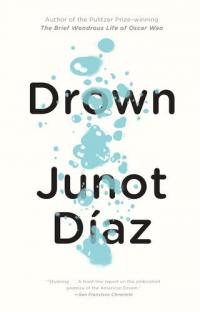
While I could talk for hours about The Brief Wondrous Life of Oscar Wao, this post will focus on Diaz’s short story “Aurora” in the collection Drown. Since I originally created this blog to review short fiction, I hope to continue this for as long as possible. After finishing the first four stories in Drown, I can safely say that the literary quality of Diaz’s short fiction is on par with TBWLOW. His stories exhibit the same kind of voice and style present in his longer work. The same narrator is present in both Drown and TBWLOW, making the two works feel like companions to each other. Most authors I’m familiar with switch narrators frequently, while Diaz is content to keep the same narrator. As a part-time writer of fiction, this makes sense to me as it maintains a common thread throughout multiple books. When you can keep something the same in multiple stories, this lessens the amount of work for the writer. The narrator’s name is Yunior and for lack of a better term, he’s a douche. He spends the majority of his time womanizing to build up his fragile ego. In his defense, Yunior does seem to mature later, but his early life is rife with abuse perpetrated by and against him. It’s critical to discuss Yunior because he is always present in both Drown and TBWLOW. With Yunior, Diaz has created a character who may not be likeable, but has arguably redeemed himself by telling us the stories in the first place.
“Aurora” comes at a point when Yunior seems to be in high-school or possibly older. Along with his friend/co-worker named Cut, Yunior has made a steady living dealing drugs in New Jersey. It’s an interesting point in Yunior’s life because he’s making bad decisions all over the place. There’s a tension between what Yunior is doing and how he knows it’s bad. Yunior can’t seem to stop himself from indulging in activities that are dangerous and rewarding in the short-term future. The reader is presented several times with Yunior’s thoughts upon waking in which he laments his choices the prior night. One consistent form of danger comes in the form of Aurora, the title character of the story who is difficult to fully understand as a person. Aurora appears to Yunior sporadically, always ready to do drugs and have sex in exchange for something. It’s easy to dismiss Aurora as a drug-addicted burnout, yet she’s a surprisingly complex character. She’s appealing enough that Yunior describes his relationship with her as love, despite how it sometimes looks like abuse. To me, the story presented a commentary on love as something hard to define. Is Yunior really in love with Aurora, or is he addicted to what she provides for him physically? Yunior seems convinced that it’s love but I find myself unwilling to accept Yunior as a credible source.
The story ends in a hardly surprising difficult place. Aurora has been released from Juvenile Hall and met up with Yunior in an abandoned apartment. It’s a fleeting moment of happiness for both characters and Yunior admits that everything seems fine. It’s tragic because any semblance of normalcy in this moment will disappear because for these characters because love is intertwined with hate and normal equates with danger.

Related Posts: