January 26, 2017

The Weird Thing about this Blog

The weird thing about this blog is that it has no regular readers. Something I have come to realize recently is that if you have a blog, regularly posting is crucial if you wish to build an audience. I wish that an audience existed for my blog because I would have people to talk to about stuff literary and otherwise.

This blog has existed for almost five years and some posts such as this get a lot of views for some reason. I imagine this is because the majority of people who read George Saunders also happen to be high school english teachers who assign Saunders' stories and none of them want to read stories so they all google search "George Saunders puppy summary" so they don't have to actually think about or read the actual text.

My intention with this blog was never to rack up views. If attaining views was my goal then there would be a lot more posts on here about Minecraft, Donald Trump and the Transformers movies, etc. With that in mind, from this point forward I am going to treat this blog as a kind of diary. The key thing about this diary will be the regularity of the writing that appears on it instead of the irregularity. Eventually maybe an audience will come but that is not my goal. My goal is simply to build a regular writing habit. There will be summaries of short stories that I enjoy and want to emulate not for views but for the joy of breaking apart a story and seeing how it works. Currently I am reading David Foster Wallace's Infinite Jest and it is a total blast. It has reminded me of my love for language. I find that a philosophical interest in language is one of the traits that many writers share. I will most likely be writing about Infinite Jest soon because that is what I am currently reading and I am dying to write about it.

Anyways that's it for this post. Signing off to go read more Infinite Jest. I'm on page 103 of 1,079. Wish me luck.

January 13, 2017

Choosing your Literary Influences

One of the most important questions I ask myself as a writer is "who are my writers?"

In order to write your own fiction it is helpful to have a template for the kind of writing you want to create. This is why its important to read many different writers. This is the best way to find the variation of writing that inspires you, that you would like to emulate.

The fact is that the world is full of writers and everything has already been written about. No matter what you create it will be viewed as related to something that already exists. It is better to accept this idea that nothing is original because the alternative of believing that you are special will most likely lead to disappointment.

"Bad artists copy. Great artists steal."

What artists do you attempt to imitate or steal from in your own work? Lately I have been most focused on the work of Lydia Davis. I find that her focus on psychology is more suited to my writing style.

That's all for today.

December 27, 2016

Margins by Donald Barthelme

Margins consists of dialogue between two men named Carl and Edward. This structure gives the story a quick and snappy pace. Each line of dialogue flows into the next and there are few interruptions. The story is also approximately five pages long making it an easy read.

The title of the story refers to Carl's theory that the width of a person's margins signals something about that person's personality. "The width of the margin shows culture, aestheticism and a sense of values or the lack of them." he says. As the story progresses, Carl and Edward's characters are revealed through their dialogue. For example it is revealed that Edward is white while Carl is black.

The dynamic between the two men is best described as peculiar. Each man references historical figures such as Francois Villon and John Hawkes who is a comptemporary to Barthelme. Barthelme speaks through Carl and Edward like a puppeteer. It becomes clear that Carl and Edward are undeveloped or unrealistic characters. They could be more accurately described as voices. This suggests that character is not what is important to Barthelme because it is simply used as a vehicle to convey ideas.

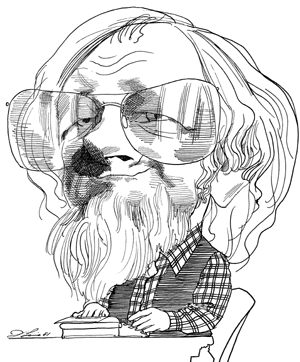
A caricature of Donald Barthelme from the New Yorker


Carl and Edward continually make snap judgement about each other based on superficial qualities. At one point Carl even says that Edward's handwriting theory is "a superficial approach to the problem." Yet Edward doesn't appear to acknowledge Carl's comment because he goes on to elaborate on the details of his theory. The dialogue is more like two monologues where each character occasionally acknowledges the other. It makes sense that the story ends with Carl and Edward slapping each other in the face. These two men don't seem to have any desire to help each other. Violence is the natural conclusion of this conversation. Thankfully they only slap each other instead of something more destructive. There is more to a conversation than being able to say what you think in an interesting way.

Buy Sixty Stories here:
https://amzn.to/2nyyrQG

December 7, 2016

Dundun

The title of this story refers to a character who Fuckhead, the narrator, visits to get some opium. Fuckhead learns that Dundun has shot another character named McInnes who is fortunately still alive. Fuckhead goes inside of a house to see for himself that Mcinnes has been shot. It looks pretty bad so Fuckhead decides that he will drive Mcinnes to the hospital with Dundun and Jack Hotel tagging along.

Mcinnes dies in the backseat before Fuckhead makes it to the hospital. Dundun says to throw Mcinnes out of the car. Fuckhead and Dundun are disturbed that Mcinnes has died but they pretend not to care.The final paragraphs of this brief story add some background to Dundun's character:

"His left hand didn't know what his right hand was doing. It was only that certain important connections had been burned through. If I opened up your head and ran a hot soldering iron around in your brain, I might turn you into someone like that." (51).

Fuckhead believes that Dundun is not in control of his actions. Fuckhead says that people like Dundun are created through a process similar to a soldering iron being ran through someones brain, burning the important connections, a disturbing image to say the least. Fuckehad wants us to understand that dangerous people like Dundun do not exist in a vacuum. They are created by other people.

The lesson of this story is that a first impressions are not necessarily correct. It's tragic that Mcinnes dies and it is normal to want to blame the person who shot him -- but Johnson reminds us that blame usually lies with much more than just one person. Trying to understand why Dundun is the way he is is more honorable a task than writing him off as a sadistic murderer. Most people would choose the latter but Fuckhead and Johnson seem to think that this choice fails to capture the entire story. I believe this is the main lesson that Johnson hopes to teach his readers.

Other people have written online about "Dundun". Check out this short but insightful piece from treehousemag.com. As Denis Johnson teaches us, it is better to understand something from multiple perspectives than it is to go with your gut reaction. If you have any thoughts or questions related to "Dundun" please leave them in a comment. Thanks for reading.

BUY HERE:
https://amzn.to/2P5hdXF


November 30, 2016

What To Do If You Are Stuck Writing a Story

As someone who reads a lot of short stories, I often think about story structure and whether or not it is an important element of effective storytelling. It makes sense that structure is related to good storytelling but how does this relationship work exactly?

The majority of my favorite stories have a structure. If you take a screenwriting course, narrative structure is going to be one of the first things you learn. The traditional method of analyzing a story is to divide it into three sections called acts. This method is interesting but I have never found it to be particularly helpful.

One of my favorite philosophies when it comes to fiction writing is that a writer should include only what is absolutely necessary. This idea is helpful to me because I usually feel like I am flying by the seat of my pants while writing. If I have planned enough in advance, then I usually can tell if what I'm writing is necessary to my story. It may be unclear if what I'm writing is necessary. In this case it is helpful to reflect on where you are and think about the various paths that your story could travel. Something that I have found helpful in this situation is Pixar's 22 Rules of Storytelling. Rule #9 explains what to do when you are stuck:

#9: When you're stuck, make a list of what WOULDN'T happen next. Lots of times the material to get you unstuck will show up. 

It doesn't matter what is on this list. The only thing that matters is making the list. This exercise is essentially a way of increasing your chances of writing something that coheres with the rest of your story. You must take a second to get all the bad ideas out of your head before anything resembling a good idea can show up. This directly relates to rule #12:

#12: Discount the 1st thing that comes to mind. And the 2nd, 3rd, 4th, 5th - get the obvious out of the way. Surprise yourself.

Unless you want to write boring stories your entire life, you should make this rule a habit. Writing the first thing that comes to your mind is a great way to create predictable stories.

Writing effective stories is difficult and it takes practice. Even if you manage to complete a first draft, you should revise that draft to make it better. Although writing stories is difficult, there are many tools to help you make it through. I find that focusing on thought processes while writing helps me recognize and thus break free from the patterns that limit my creativity. It also helps to consistently question whether what you are writing is necessary to your story. The most important question you can ask yourself while writing is "why does my story need this section?".

November 28, 2016

Car Crash while Hitchhiking Summary and Analysis

Summary


The story begins with the narrator waking up in a delirious state. The narrator has done a lot of drugs with a salesman, a Cherokee Indian and a college student. The narrator is in pain but he also seems strangely coherent. He states that he can sense things before they happen.

The narrator is picked up by a family in an Oldsmobile. The narrator knows that there will be a car crash but he chooses to say nothing and goes to sleep. The Oldsmobile crashes into another car and the narrator takes the baby into the night. Walking by the other car, the narrator notices a person lying on the ground. The narrator can tell that this person will soon die and later refers to him as the "dying man". The narrator is taken to a hospital where he sees the wife of the dying man. The wife shrieks like an eagle and the narrator states that hearing the shriek actually felt wonderful. The narrator then describes lying on a hospital bed and being given vitamins by a nurse. Then he describes an outdoor setting while directly addressing the readers of the story.

Analysis


In "Car Crash while Hitchhiking" Denis Johnson introduces us to the narrator that will remain throughout all of the stories in the book Jesus' Son. We do not learn the narrator's name until later in the book. It's a mysterious story without barely any explanation. The narrator's tone is similar to that of a journalist attempting to describe something as clearly as possible. The problem is that the narrator is high on several kinds of drugs which threatens the reliability of his story. The ending of the story presents the possibility that the entire story is just a hallucination occurring in the narrator's mind. Although we have no reason to suspect that the narrator is a bad person, his actions in the story make him seem self-interested. 

Another reasons why I believe this story occurs in the narrator's head is that he claims to possess the ability to see the future. I find it hard to understand why Johnson chose to include this element in the story. It does not serve a purpose for the story, seeing how the narrator does not act on his premonitions. The narrator is either too stoned or too tired to share his knowledge of the future. The only times the narrator expresses any feelings on the events taking place are when he sees the dying man on the road and when he hears the wife of the dying man shriek in the hospital. The narrator does not express grief during these moments but he does express feelings of awe.

"Car Crash while Hitchhiking" is an aberration of normal storytelling. There is a climactic event some exposition but none of the characters possess an arc and the story might be merely a figment of the narrator's imagination. There is more work than usual on the reader's end to find meaning because the story's purpose is unclear. 

If you found this article helpful, you can support Short Fiction Daily here: 

Buy Me a Coffe

November 16, 2016

"Thief" by Jess Walter: The Senselessness of Guilt

In the stories I have read, Jess Walter tends to focus on blue-collar people or worse. "Thief" is no different. The story is about a family of five. Each family member's persona, except for the mother, is described in detail because each is a suspect. The father Wayne is tearing himself apart trying to understand why one of his children would steal loose change from the family vacation fund. At first I thought the father was the thief because he prowls around the house at night examining his children, however the father is simply a workaholic and possibly a drunk who thinks a lot about his friend Ken's affair with a woman named Donna. Caring about the Father's dilemma is difficult because the stakes of the story don't seem very high. Who cares about a few cents here and there.

Wayne has fond memories of the vacations his family took when he was a child. He smiles while telling his wife about a trip to Yellowstone. The vacation fund is a tradition that started with Wayne's father. It takes two years before the family has enough money to take a vacation. Early on Wayne tells his wife why the missing money is a problem: "You want one of your kids stealing from their own goddamn family? You want your kids to be like this?" On his day off Wayne pretends to leave for work and instead hides in the closet, hoping to catch the thief in the act. Wayne hear the thief take money from the jar but he doesn't have the nerve to confront them. When the thief has left the room, Wayne can only reach for a beer. And here is where the story takes a turn. The narrator several numerical facts about the family in quick succession: "The house cost $44,000. The interest rate is 13 percent. The father works rotating shifts at a dying aluminum plant - day, swing, graveyard - for $9.45 an hour, and he comes home so tired, so greasy, so black with soot and sweat that he unrecognizable, and yet, every day he gets up to do it again." The ending completely changes how we view the rest of the story. Wayne becomes a messiah-like figure who dies everyday for his family's sins. You understand the father's struggle on a deeper level. Life is extremely difficult and Wayne struggles everyday to make ends meet with only the faint hope of a vacation every two years to motivate him. Sometimes the people we love don't realize the true consequences of their actions. The thief "burns with shame" but shame is not enough to keep the thief from stealing. What's on the surface is rarely enough to fully understand something. The truth is always far more complicated than appearances suggest. Few writers capture this idea better than Jess Walter.

Buy We Live in Water here:
https://amzn.to/2MMtajd