August 13, 2017

Late Fragment by Raymond Carver Analysis

And did you get what
you wanted from this life, even so?
I did.
And what did you want?
To call myself beloved, to feel myself
beloved on the earth.


I am no stranger to Raymond Carver's prose but I cannot say the same for his poetry. Carver is known for a minimalist style championed by his editor and teacher Gordon Lish. These days I find it harder and harder to sit down and read an entire story. Perhaps looking at poetry will get me back in the groove of reading and writing about literature.

The first thing I noticed about Carver's poem 'Late Fragment' is its short length. The poem is six lines long and one line is only two words. The poem reads quickly. I felt I understood the poem completely after reading it two or three times. Lines two and four as a question that is then answered in the following line.

Enough about the poem's structure. Let's get into the content. The repetition of the question "what did you want?" seems to be the essence of the poem. The speaker is asking this question to himself or perhaps to someone else. Whoever is answering the question knows that he has got exactly what he wanted from life. It's the kind of question one would ask in his or her final moments when there is nothing to hide. In typical Carver fashion, the answer is frank: "to call myself beloved, to feel myself beloved on the earth." 

Love is a prominent theme in Carver's fiction as well as in his poetry. I think we could all use a bit more love in the world, especially given the current political climate. We can look to writers such as Carver to remind us what is important in life. What's important to Carver is feeling loved and calling himself loved. It's a simple answer to a question that is often answered with money, power or fame.

Thank you Raymond Carver for reminding me what is truly important in life.

June 12, 2017

Analysis of 'Sea Oak' by George Saunders

I have read many of George Saunders' stories over the past few years. It's surprising that I have yet to write about 'Sea Oak'. The hero of this story works as a male stripper at an establishment called Joysticks. It's common for the customers at Joysticks to offer the employees money in exchange for a flash of the genitals or a picture of a butt. Clearly the men working at Joysticks are objectified yet the main character seems grateful for his job. Perhaps the fact that he is rated a "honeypie" provides a boost to his self-esteem.

Saunders is no stranger to inventing bizarre work environments. This is actually one of his go-to techniques as a fiction writer. The heroes of these stories encounter problems when they fail at their jobs (see 'The Wavemaker Falters') or they are pressured to break the rules. (see 'Offloading for Mrs. Schartz'). Sea Oak is different because the inciting incident of the story involves the hero's life away from work.

Humor is the most effective element of 'Sea Oak'. If any story proves that Saunders is a master of comedy, this is probably the best example. It seems like every section ends in a punchline that propels you into the next section. Sometimes it feels as though the jokes are making fun of the characters so I could see how someone might find the humor offensive. But this type of humor usually works on me pretty well.

There are so many things going on in 'Sea Oak' that it can seem a bit overwhelming. The most integral part of the story is the death and resurrection of Aunt Bernie. There is no explanation for why this happens. Aunt Bernie rises from the dead to deliver life advice to the members of her family. "Show your cock" she says to the narrator so that he can make more money at work. I wonder how Saunders conceived of this aspect of the story because it's ludicrous. This foreshadows some of the bizarre plot events that occur in his later stories.

'Sea Oak' ends on a strangely uplifting note. The is a story where the characters seem to be on a downward spiral into poverty. The narrator's plan to "show his cock" seems to work because he is planning to move his family into a safer apartment. But I would hesitate to call 'Sea Oak' an inspiring story. After reading 'Sea Oak" you come away with better understanding of people living in austere environments. If you have lived you entire life comfortably, then this is an important idea to learn.

If you found this article helpful, you can support Short Fiction Daily here: 

Buy Me a Coffe


June 7, 2017

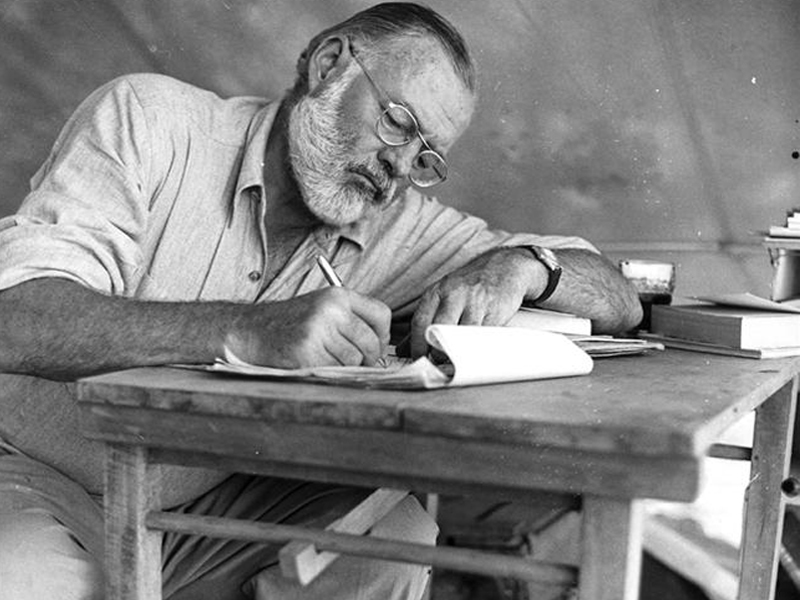
Ernest Hemingway Wearing Glasses

Here is every photo ever taken of Earnest Hemingway wearing glasses.

Hard at work.

Pondering the nature of the universe.
"Hey! I like your beard"
No comment.
Those yellow shades really complement your eyes


June 3, 2017

Analysis of 'Television' by Lydia Davis

Lydia Davis is known for her experimental stories that are often quite compact. She experiments with form more than any other contemporary writer. 'Television' is a four-page exploration of what television does for people watching it and how television makes life better.


Imagery


In describing what is on TV, the narrator uses vivid imagery. There are zombies, a woman with a pearl necklace, a mother with bad teeth, a father with a broad smile. The images we see on television are so realistic that reality becomes secondary. Or perhaps reality is filtered through the medium of television, but it is always someone else's reality. The voyeurism of watching television is what makes it so appealing but this would not be possible without the realistic and vivid pictures that TV displays.


Unique Structure


'Television' is divided into three distinct sections that are roughly the same length. The first section focuses on the reasons why people watch television. There are many sentence long paragraphs. The second section is also choppy with several paragraphs separated by a single line. The third section contains four longer and connected paragraphs about the narrator's individual experience watching movies late at night. TV becomes an escape for the narrator away from her own life and into other more interesting lives. The many line breaks and transitions has the effect of giving the story a faster pace and it makes the story easy to read. I feel that the structure of the piece is a reflection of the narrator's internal dialogue.


Moral of the Story


After reading this story over a few times, I came to the conclusion that TV is quite helpful. TV seems like the perfect tool for escaping from your own life when it gets stressful and TV also provides entertainment. While the story never explicitly states that TV is good, it can be inferred from statements such as, "there is some real satisfaction in getting this information about the next day's weather" or "they say it will be exciting and it always is"

For a lonely person, television can be a godsend. Rather than waste away doing nothing, TV at least provides a way of killing time that is not entirely useless. For busy people, television is a welcome distraction from the stress and monotony of daily life. Television, when used responsibly, is an amazing tool. If you have been raised your entire life with television, it is incredibly difficult to imagine life without it.

Television is good. This was my takeaway from reading 'Television' by Lydia Davis.

If you found this article helpful, you can support Short Fiction Daily here: 

Buy Me a Coffe

March 22, 2017

"Any Corpse" by Brian Evenson

An unforgettable masterpiece from the best horror writer working today.


As I read through Brian Evenson's latest collection of stories "A Collapse of Horses" certain stories linger with me longer than others. The first story with such an effect is "Black Bark" which you can read my thoughts on here. Another story that is difficult story to forget is "Any Corpse" which I am going to write about now.

"Any Corpse" begins with a shower of raw flesh falling from the sky. We have a female POV observing furnishers, human-like creatures that prod at the raw flesh and attempt to sell it in exchange for beads. We then learn that our female protagonist desires an alive and in tact human body. The premise of this story is bizarre to say the least. We learn that our protagonist is one of many who live in caves and who possess a tablature used to perform a ritual. Later the protagonist asks the furnishers for a corpse. The furnishers respond by asking "what corpse?" to which the protagonist says "any corpse," so long that it is freshly dead. The protagonist fails to understand that "any corpse" includes herself so she is killed by the furnishers. 

After the furnishers kill the protagonist, they expect the protagonists corpse to provide payment. The furnishers would almost be adorable if they weren't murderous humanoid creatures who make a living selling flesh. What's frustrating about this story is that we don't know enough about the furnishers. Why are they called furnishers? What are beads and why do the furnishers desire them? I would very much like to pick Evenson's brain to understand where he got the inspiration for this story.


In the second half of this story, we switch to a male protagonist in the same situation as the first one. He also is searching for a recently deceased body. He meets up with some furnishers and buys the woman's body from the first half. He performs a ritual that revives the corpse and begins asking questions. The corpse is not exactly cooperative. She ends up spitting in the mans face before she dies again for good. 

Later on our male protagonist intends to cook and eat the woman's body. A group of furnishers come to the man's cave. The man asks for another body and ends up making the same mistake as the woman by saying that any corpse will do. The story ends with the furnishers gathered outside of the cave saying "person please out of cave."

While reading Evenson's stories, I often feel just as confused as the characters in said stories. I find myself motivated to read his stories because I want to understand the mysterious events taking place. Unfortunately I am never able to satisfy this urge. When the story ends I am just as clueless as when I started reading. Evenson does not explain why his stories are so weird. Doing so would take away from their power. Evenson's best technique is how he creates such disturbing stories without ever explaining how they work. It is clear that too much explanation would be detrimental to the effect that Evenson hopes to create. The more that we understand what's going, the more comfortable that we feel. Evenson is clearly a literary madman whose goal is to make his readers as confused and as disturbed as possible.

If you found this article helpful, you can support Short Fiction Daily here: 

Buy Me a Coffe

March 7, 2017

Black Bark by Brian Evenson

Summary and Analysis


Brian Evenson's Black Bark is a story you could read a hundred times and you still would not understand what's going on. It's a story with supernatural elements that refuses to explain why they exist. Reading the story is like briefly entering another world that is frightening yet oddly entrancing because you are dying for an explanation as to what is going on.

Black Bark is about two characters named Sugg and Rawley. Both are cowboys riding horses looking for a cabin that may or may not exist. They are apparently running away from something and Sugg has suffered a nasty injury to his leg. Rawley is the protagonist of the story. The reader is meant to experience the story through Rawley's perspective whereas Sugg functions as an antagonist to Rawley. The weird thing about Sugg is that he disappears seemingly out of thin air several times in the story which makes me think that he does not actually exist. Sugg's disappearing act is the only supernatural element in the story. Sugg also sticks his hand into a fire without reacting and tells Rawley a weird story called "Black Bark" about a man who finds a piece of black bark in his pocket that keeps reappearing even after the man takes the bark out of his pocket.

The presence of this story within a story sheds light on the themes of this story. Rawley's main reaction to the story is that of confusion. He wants a deeper explanation of the events that are left out of black bark but Rawley refuses, claiming that he is presenting the story as it is. Sugg's story is the kind of thing you would imagine while you were tripping on acid. This make Rawley's reaction to the story quite understandable.

What I love the most about this story is how crazy and mysterious it is. The setting by itself is intriguing before it introduces the bizarre elements of Sugg's character. It's compelling to watch Rawley struggle to keep himself alive while dealing with whatever the hell is going on with his companion. At the end I was left with the question of whether Sugg was a figment of Rawley's imagination or some higher power was speaking through Sugg. A recurring image in the story is that of the blood angel that appears on Sugg's horse and later on the ground where Sugg lies in a cave. The blood angel is described as vaguely human shaped. Perhaps this is the symbol of whatever high power is controlling the environment in this story. It's incredible what kind of work your mind will do to explain what's going on when not everything is explained.

I believe that is the main goal of Evenson's story: to create a situation where not everything is explained and the events are compelling. This drives the reader to create their own explanations because it is uncomfortable not knowing why these things are happening. It's also a lot easier on Evenson's part to not have to explain the workings behind the strange events in the story. Why should Evenson have to explain why things are the way they are? Is that what a story is supposed to do?

People are raised on stories that mimic reality where all that happens is consistent with the rules of reality. But a story is not reality. A story is a collection of words on a page assembled to create meaning and there are ways to create meaning that exist outside of the normal mode of storytelling. Evenson is one of the best writers at making you feel that disturbed uncanny valley feeling. I greatly enjoyed this story and I look forward to reading and writing about more of Evenson's stories in his new collection. If there is one writer I hope to emulate in my own writing, it is Brian Evenson. I feel his methods for fiction writing are both practical from the perspective of a writer and useful for creating stories that linger with a reader long after the story has been read.

If you found this article helpful, you can support Short Fiction Daily here:

buymeacoffee.com/shortfictiondaily

February 23, 2017

Revelation - Flannery O'Connor

Revelation by Flannery O'Connor is narrated in the third person. The main character in the story is a woman named Mrs. Turpin who firmly believes that people such as herself are superior to other people. If you have read any of Flannery O'Connor's other stories, then you know that this is the type of character who is usually punished in O'Connor's fiction. O'Connor spells out Mrs. Turpin's hypocritical worldview in the following way:

"There was nothing you could tell her about people like them that she didn't already know. And it was not just that they didn't have anything. Because if you gave tehm everything, in two weeks it would all be broke nor filthy or they would have chopped it up for lightwood. She knew all this from her own experience. Help them you must, but help them you couldn't."

Mrs. Turpin is an expert at finding reasons to think that other people are less than her. The Christian sentiment that it is important to help those less fortunate than oneself is undercut by Mrs. Turpin's theory that the less fortunate people of the world are beyond help due to their nature. This idea is fundamental to Mrs. Turpin's worldview.

The most entertaining portion of this story occurs when Mrs. Turpin is attacked by a young lady while sitting in a doctor's waiting room. The lady calls Mrs. Turpin a "wart hog from hell" before she is escorted away by security. This insult shakes Mrs. Turpin down to the core. When she's back at home, it is all she can think about. She is utterly unable to understand how anyone could see her as a "wart hog from hell" because she sees herself as an embodiment of God's chosen people. Later on Mrs. Turpin is washing down the hogs at home when she has a holy hallucination that brings home the main point of the story:

"There were whole companies of white-trash, clean for the first time in their lives, and bands of black niggers in white robes, and battalions of freaks and lunatics shouting and clapping and leaping like frogs. And bringing up the end of the procession was a tribe of people whom she recognized at once as those who like herself and Claud, had always had a little of everything and the God-given wit to use it right."

This vision suggests that all are equal in the eyes of God since all classes of people can be seen walking towards heaven. The fact that Mrs. Turpin sees people like herself at the end of the procession may suggest that she is the last to get in to heaven. It's surprisingly difficult to interpret this final vision of the story because it doesn't cater to the reader's expectations. We expect Mrs. Turpin to finally understand that everyone is equal and that she has lived a life of unjustified superiority. What Mrs. Turpin is unable to understand is why the people whom she perceives as less worthy than herself are just as entitled to heaven.

This ending is too religious for me. I am culturally Jewish but I have never been religious in the sense that I believe in a literal God or afterlife. This is what makes reading O'Connor's stories difficult for me. Its hard to put myself in the shoes of anyone who makes religion the first priority in their life. I don't have anything against religion or religious people but most of the time I don't really see a difference between religion and brainwashing. So when characters in a story have religious visions without the aid of hallucinogenic drugs, I get a little annoyed because it reminds me that what I am reading is ultimately one person's view of how the world works. Stories such as "good country people" and "A Good Man is hard to find" are some of my favorites stories ever, but I can't help but think of Flannery O'Connor as someone who watches Fox News and takes it as fact.

If you want to read someone else's thoughts on "Revelation" check out this post from the Sitting Bee, a site that I hope will one day be talked about in the same conversation as Short Fiction Daily.

As always thank you reading and feel free to leave your thoughts in a comment below. Also check out some of my other posts on Flannery O'Connor stories that I have enjoyed a lot more than this one.

Related Posts:
Buy Here: